
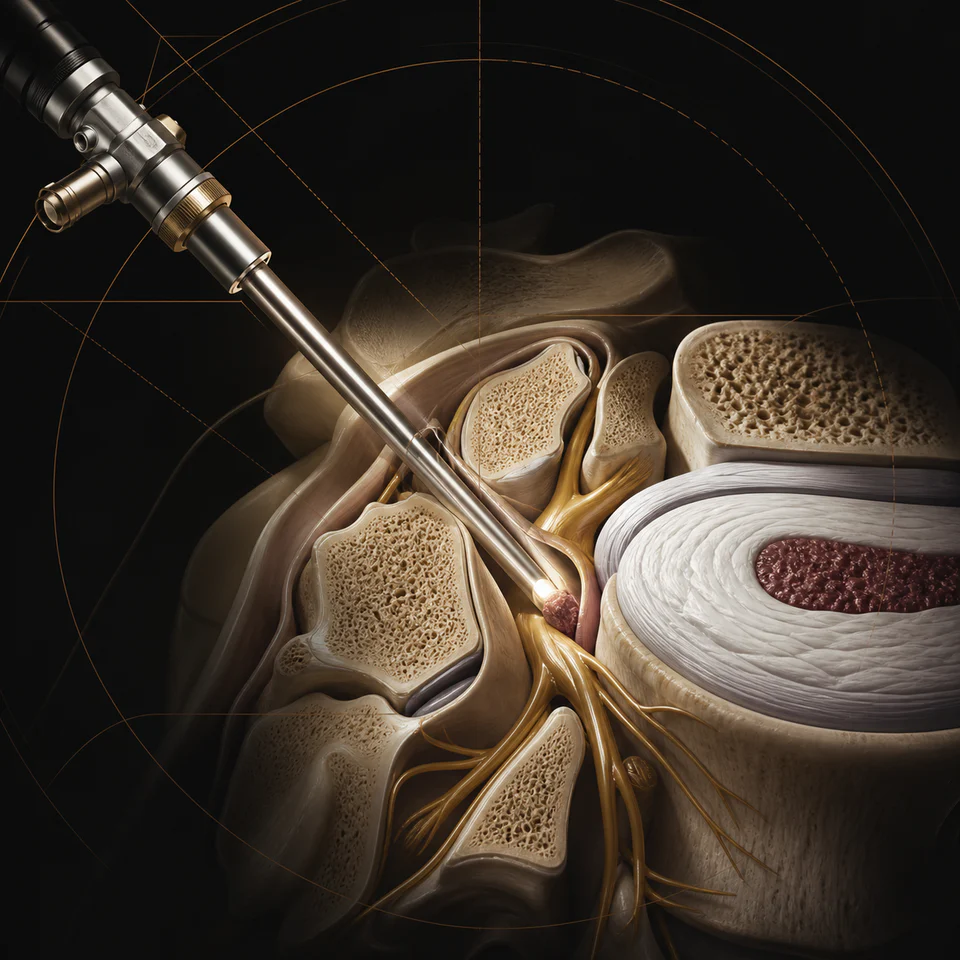
Endoscopic and minimally invasive spine surgery use focused working corridors, advanced imaging, and specialized instruments to reach the source of nerve compression while limiting disruption to surrounding tissue.
Endoscopic & Minimally Invasive Spine Surgery Q&A
How do endoscopy and MISS differ from traditional laminectomy?
A traditional open laminectomy generally requires a larger skin incision and broader separation of the posterior spinal muscles to expose the lamina. Endoscopic spine surgery and other minimally invasive spine surgery (MISS) techniques use smaller access channels and targeted visualization.
What advantages may smaller-access surgery offer?
For appropriately selected conditions, potential advantages include:
- Lower blood loss
- Less disruption of the paraspinal muscles
- A smaller skin incision
- A more focused path to the area of nerve compression
These advantages vary with the condition, anatomy, and procedure. A consultation is used to determine whether an endoscopic, minimally invasive, or other approach is appropriate.
What is single-portal joimax endoscopy?
Single-portal endoscopy brings the camera, illumination, irrigation, and working instruments together through one focused access channel. Dr. Bhamb uses joimax endoscopic systems, with the approach selected for the anatomy and the location of the compression.
How can endoscopy reach the far-lateral disc and foramen?
Disc fragments and bony narrowing can compress a nerve in the foramen, where the nerve exits the spine, or just beyond it in the far-lateral region. These areas can be difficult to reach through a traditional midline exposure. For selected cervical and lumbar conditions, a route-specific endoscopic corridor can provide direct visualization and allow Dr. Bhamb to remove disc or bone material around the affected nerve.
How does Dr. Bhamb choose between endoscopy and MISS?
The choice depends on the location and type of compression, spinal stability, prior surgery, imaging, symptoms, and the goals of treatment. Dr. Bhamb uses the smallest appropriate access pathway that can safely address the problem.
To learn whether endoscopic or minimally invasive spine surgery may fit your condition, call Bhamb Spine to request a consultation.