
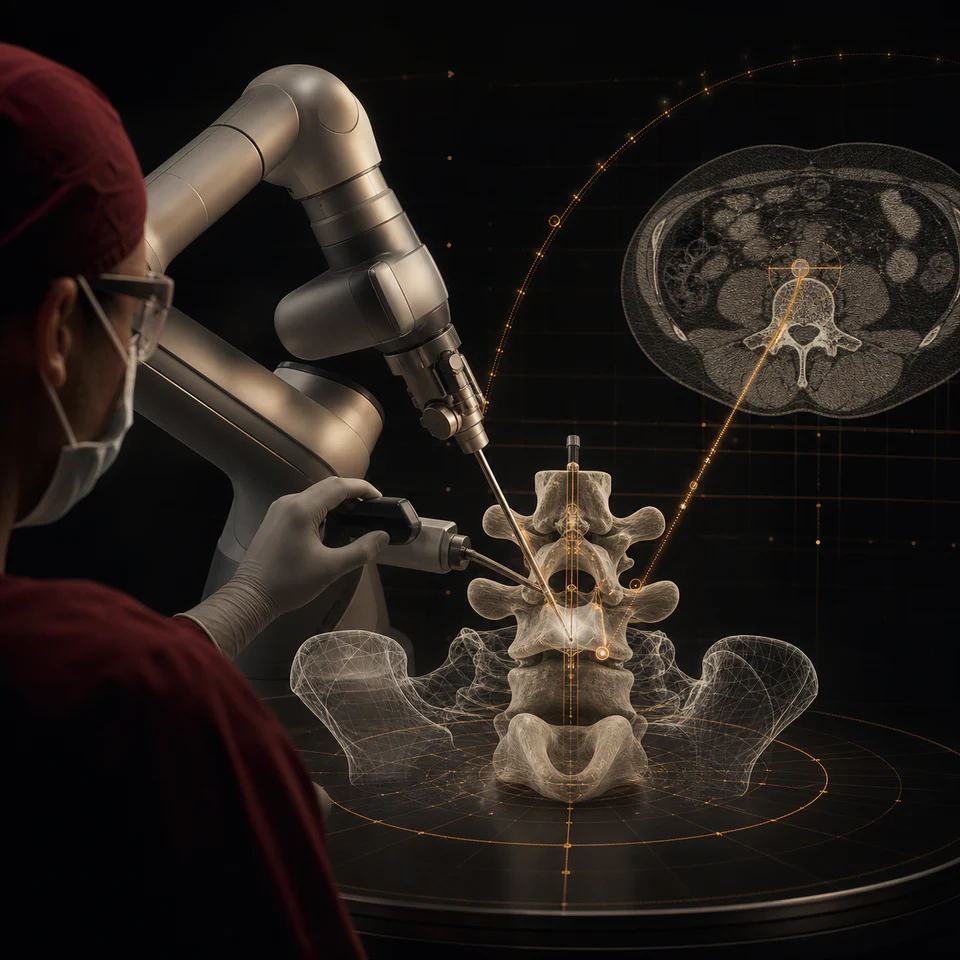
Robotic spine surgery combines three-dimensional imaging, computer-based planning, instrument tracking, and surgeon-controlled guidance to support technically demanding procedures.
Robotic Spine Surgery Q&A
What does a spine robot do?
A spine robot does not operate independently. It helps the surgeon plan and maintain an intended instrument trajectory while the surgeon remains in control of every step of the procedure.
How does the Globus ExcelsiusGPS platform support a procedure?
The Globus ExcelsiusGPS platform combines a rigid robotic arm with surgical navigation. Preoperative or intraoperative CT images can be used to plan trajectories, while tracked instruments and implants are visualized relative to the patient’s anatomy in real time.
What is CT-based stereotactic navigation?
CT-based stereotactic navigation creates a three-dimensional map of the operative anatomy and registers that map to the patient. Tracked instruments can then be displayed on the CT-based model to help the surgeon understand position, angle, and depth during the procedure.
What is G-Arm imaging?
G-Arm is a biplanar X-ray imaging system that can display front-to-back and lateral views at the same time. These complementary views can support real-time orientation while reducing repeated repositioning of a conventional single-plane imaging arm.
How can these technologies complement one another?
Depending on the anatomy and procedure, Dr. Bhamb may use robotic guidance, CT-based stereotactic navigation, or biplanar imaging as complementary tools for planning, orientation, and instrument guidance. The technology is selected for the individual operation rather than used as a substitute for surgical judgment.